Every manager has a favourite way of leading. Some give clear instructions and check in often. Others step back and let people get on with it. Both work, for some people, some of the time. The problem comes when one style is used on everyone. This guide explains the four situational leadership styles in Blanchard’s SLII® Model, how to choose the right one for each person and task, and what each looks like in a real conversation.
What is a situational approach to leadership?
A situational approach to leadership starts from one simple idea: there is no single best leadership style. The right style depends on the person you’re leading and the specific goal or task in front of them.
SLII® is Blanchard’s model for doing this well. Leaders learn to look at two things for each goal, a person’s competence (their skills and knowledge for that task) and their commitment (their motivation and confidence), and then give the matching amount of direction and support. That’s why it’s often described as situational leadership training: it teaches managers to adapt rather than lead everyone the same way.
The two behaviours behind every style
Each of the four styles is a different mix of two kinds of leadership behaviour:
- Directive behaviour: telling and showing people what to do, how to do it and when. Setting goals, giving clear instructions, checking progress.
- Supportive behaviour: listening, encouraging, asking for ideas, explaining the why, and building confidence and involvement.
High or low amounts of each give you the four leadership styles.
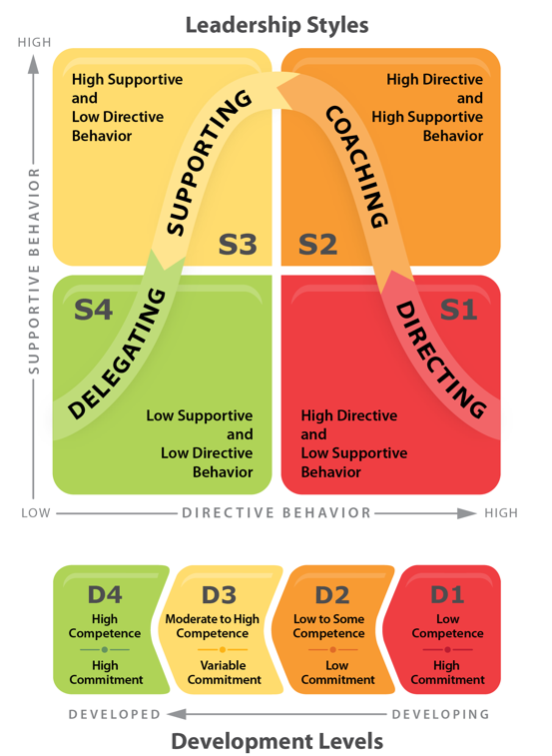
The SLII® Model. © Blanchard. Used with permission as a Blanchard Authorized Partner.
The four leadership styles in SLII®
S1 Directing: when someone is new to a task
Use it for people who are keen but don’t yet have the skills for this particular goal. They need clarity more than encouragement: what good looks like, the steps, the deadline and when you’ll check in.
S2 Coaching: when the early enthusiasm has dipped
After a promising start, many people hit a wall. The task turns out to be harder than expected and confidence drops. They still need direction, but now they also need support: explanation, encouragement and the chance to ask questions.
S3 Supporting: when someone is capable but cautious
This person has the skills but may lack confidence, or their motivation varies. Telling them what to do would feel like micromanaging. Instead, ask, listen and help them trust their own judgement.
S4 Delegating: when someone is a self-reliant expert
For people who are highly skilled and motivated on a goal, the best thing a leader can do is get out of the way. Agree the outcome, give them ownership and recognise their contribution.
Matching the style to the development level
In SLII®, a person’s development level is diagnosed for a specific goal or task, not for the person as a whole. There are four development levels, and each has a matching leadership style:
| Development level | Competence | Commitment | Matching style |
|---|---|---|---|
| D1 | Low | High | S1 Directing |
| D2 | Low to some | Low | S2 Coaching |
| D3 | Moderate to high | Variable | S3 Supporting |
| D4 | High | High | S4 Delegating |
This is why SLII® involves three skills: goal setting (agreeing clear, specific and trackable goals), diagnosing (assessing development level on each goal) and matching (using the right style).
Example: one person, three different styles
Priya is an experienced finance analyst. On her monthly reporting she is an expert, so her manager delegates (S4) and just reviews the headline numbers. She has recently started presenting to the board, which she can do but finds nerve-racking, so her manager supports (S3): rehearsing with her and asking what she wants to emphasise. And she has just been asked to lead a supplier negotiation for the first time, so her manager directs (S1): setting out the objectives, walking through the process and agreeing regular check-ins.
Same person, same manager, three different styles. That’s a situational approach to leadership in practice.
Two common mistakes: over-supervision and under-supervision
- Over-supervision is using too much direction for someone who doesn’t need it. It frustrates capable people, slows things down and is a common reason good people leave.
- Under-supervision is leaving someone alone too early. It feels like trust, but people who are new to a task can struggle quietly until mistakes appear.
Two other traps are diagnosing the person rather than the task, and assuming a development level without asking. The best SLII® conversations are done with the team member, not to them.
See the SLII® Model explained

Video: The Power of SLII®, © Blanchard.
We’re a Blanchard Authorized Partner. Our one-day SLII® programme teaches teams of managers to set goals, diagnose development levels and match their leadership style, at your premises or live online.
Is SLII® the same as Situational Leadership®?
No. Situational Leadership® was the original model developed by Paul Hersey and Ken Blanchard in the late 1960s. Ken Blanchard and colleagues went on to develop SLII®, building on decades of research and practice, and it is Blanchard’s model today. If you’re looking for situational leadership training for your managers, SLII® training is the modern, research-based approach.
Frequently asked questions
What are the four situational leadership styles?
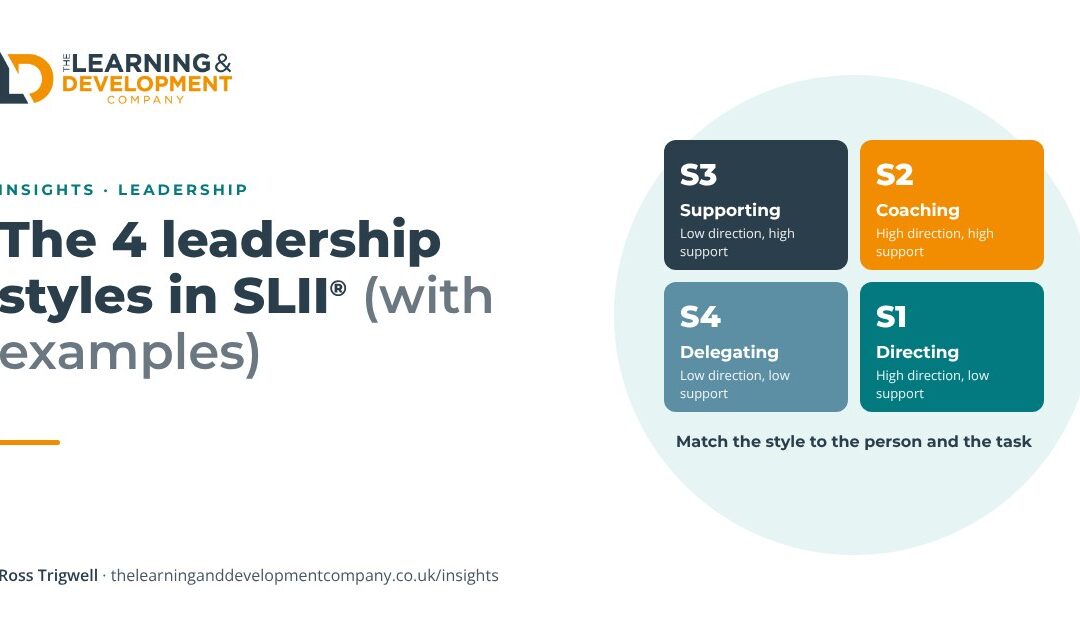
In SLII®, the four leadership styles are S1 Directing, S2 Coaching, S3 Supporting and S4 Delegating. Each is a different mix of directive and supportive behaviour.
How do I know which leadership style to use?
Diagnose the person’s development level for the specific goal, based on their competence and commitment, then use the matching style: D1 with Directing, D2 with Coaching, D3 with Supporting and D4 with Delegating.
Can one person need different leadership styles?
Yes. Development level depends on the task, so the same person can need Delegating on one goal and Directing on another.
Is there a best leadership style?
No. Each style works when it matches the person’s needs on that goal. Problems come from over-supervising capable people or under-supervising people who are new to a task.
Where can my managers learn SLII®?
We deliver one-day SLII® training for teams of managers and leaders, in-house across the UK or live online, as a Blanchard Authorized Partner.
SLII® is a registered trademark of The Ken Blanchard Companies. Situational Leadership® is a registered trademark of The Center for Leadership Studies.